


- Capability Case Study / Education Anywhere
Learning Without the Limits
of Traditional Internet.COLife helped develop the commercial plan and functional demonstration for a distributed-content ecosystem designed to bring interactive digital education to remote communities across Sub-Saharan Africa.
2021 Business-Plan Scenario for the Target Country14M+ Total Households Modeled target-country market<1.2M Always-On Power & Internet Households estimated with both12.8M Remaining Households Many in remote or underserved areas3.7M+ Children Challenged By conventional internet-based deliveryThe OpportunityExtend Digital Learning Beyond the Reach of Broadband
Many students live beyond the practical reach of reliable, affordable internet connectivity. Yet the educational experience increasingly depends on digital lessons, interactive content, learning platforms and measurable student progress.
The LearningSpots concept addressed this gap by combining content creation, one-to-many distribution, edge storage and local Wi-Fi access. Students could interact with digital coursework on familiar devices without needing a conventional internet connection for the learning session itself.
Create once. Distribute broadly. Store locally. Learn interactively—even where traditional broadband cannot economically reach.The Access ChallengeEducation Cannot Wait for Universal Broadband
The solution had to address infrastructure, affordability and the need for a genuinely interactive learning experience at the same time.
01 / REACHGeographic Isolation
Students in remote communities may live far beyond fiber, cable and economically viable conventional last-mile infrastructure.
02 / AFFORDABILITYConnectivity Cost
Even where mobile or fixed connectivity exists, continuous data access may remain unaffordable for households, schools or communities.
03 / EXPERIENCEMore Than Static Content
The objective was not simply to broadcast lessons, but to provide an interactive digital-learning experience with student-progress data.
The Solution ModelFour Layers. One Connected Learning Experience.
The architecture separated content distribution from local content access, enabling an internet-like experience without continuous internet delivery.
01Create & Publish
Educators create interactive lessons once within an education platform aligned with the country's curriculum and learning requirements.
02Package & Distribute
Content-distribution software packages and publishes lessons through a satellite, broadcast, telecom, cable, wireless or IP network.
03Store at the Edge
Industrial edge gateways located within communities receive and store the content, then create a local Wi-Fi environment for access.
04Learn & Report
Students use phones, tablets or computers locally. Progress data can be returned to the learning platform over a low-bandwidth connection.
The 2021 design contemplated a local return connection of at least 128 kbps for student-progress statistics—substantially less bandwidth than would be required to deliver the full learning content interactively.
Network-Agnostic DistributionSatellite Was the Example—not the Limitation
The featured model used satellite because of its ability to reach large geographic areas efficiently. However, the underlying architecture was designed around one-to-many content delivery and could be adapted to other available network infrastructure.
This flexibility allows the distribution approach to reflect the geography, infrastructure and economics of the market being served.
Satellite / DTH Digital Terrestrial One-Way Cable Fixed Telecom Mobile Networks Last-Mile Wireless IP Networks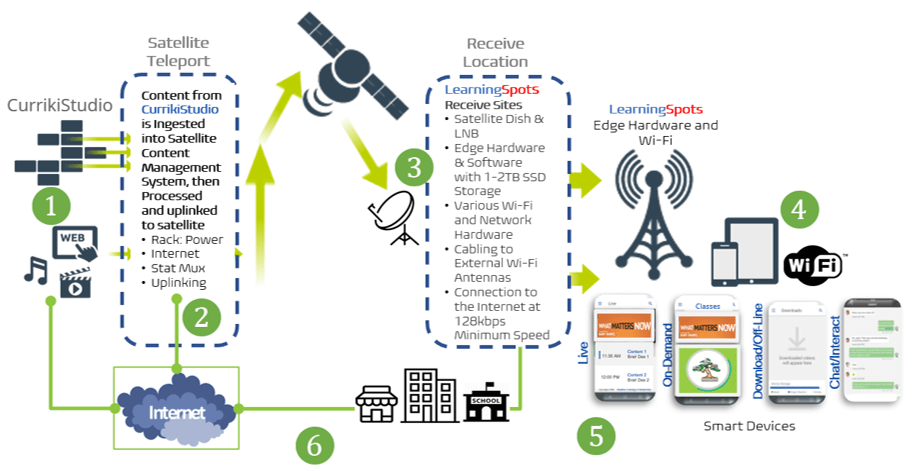
Existing LearningSpots architecture illustration from the original case study. Technology CollaborationSpecialist Platforms Working as One Ecosystem
The concept combined established capabilities for education-content creation, reliable distribution and localized edge access.
Learning Platform Curriki
Education-technology capabilities for creating interactive learning experiences and publishing content across learning-management environments.
Visit Curriki.org →Content Distribution Quadrille
Software designed to distribute live and file-based digital content to edge devices across broadcast and IP network environments.
Visit Quadrille.fr →Edge Access Noovo
Industrial-grade edge media gateways enabling locally stored content to be accessed by nearby users through familiar connected devices.
Visit Noovo.co →COLife's RoleFrom Concept to Commercial Framework
COLife coordinated business, technology, platform and market-development expertise to shape the opportunity and demonstrate how the ecosystem could work.
Ideation & Service Definition Defined the core use case, service experience, market need and long-term opportunity.
Commercial Business Plan Developed the business, operating, funding and commercialization framework.
Technology Assessment Evaluated the platforms, delivery technologies, devices and integration requirements.
Platform Integration Coordinated the functional relationship among content creation, distribution and edge access.
Functional Demonstration Helped create a working demonstration to communicate and validate the service concept.
Go-to-Market Planning Developed market-entry, stakeholder, organizational and long-term commercialization inputs.
Commercial SustainabilityMultiple Paths to Fund Access
The business plan considered several potential funding structures so the model could be adapted to government priorities, development programs, nonprofit initiatives and household affordability.
✓ Government-funded national or regional education programs✓ NGO-supported access and family microfinance programs✓ International development and multilateral funding✓ Nonprofit sponsorship of devices and annual service access✓ Free, sponsored, advertising-supported or subscription content modelsDelivery RoadmapFour Phases From Plan to Scale
The opportunity was organized as a progression from commercial definition through implementation, launch and long-term growth.
01 / PLANCommercial Plan
Define the market, users, services, partners, business model, funding and operating structure.
02 / BUILDPlatform Implementation
Configure and integrate the content, distribution, edge and user-access components.
03 / LAUNCHService Introduction
Deploy initial locations, onboard stakeholders and validate technical and user operations.
04 / SCALELong-Term Commercialization
Expand coverage, content, participation and sustainable revenue or funding pathways.
Intended ImpactBridge the Digital Divide Without Waiting for the Divide to Disappear
The project demonstrated a practical architecture and commercial framework for extending digital education and other important content beyond the boundaries of conventional internet delivery.
01 Reach remote students across a wide geographic service area02 Make interactive digital learning locally accessible03 Reduce dependence on continuous high-bandwidth connectivity04 Allow educators to create once and publish across many locations05 Reuse the infrastructure for education, information and other contentEducation Beyond ConnectivityBring Learning to the Community.
Not the Community to the Network.COLife can help governments, education organizations, development partners and technology providers evaluate and structure connected-learning opportunities for underserved markets.